Custom Search

ABOUT THE AUTHOR

Mark Timothy J. Libunao is a 32-year old registered Medical Technologist, a father to a 5-year old amiable and smart little boy and a husband to a registered Physical Therapist. He is an accomplished campus journalist, student leader, businessman, salesman and most of all, a loving father and husband, an obedient son, a caring brother, a very loyal and dear friend.


An Editor-in-Chief of his high school and college publications, a student council president for three years in college, a volunteer grade school teacher and a social mobilizer who was able to spearhead various community projects in Quezon City. He led several national organizations including the Quezon City Red Cross Youth Council, College Editors' Guild of the Philippines, Jesuit Volunteers of the Philippines and Philippine Society of Medical Technology Students. His glorious years came when he was elected as a student commissioner of the National Youth Commission under the Office of the President of the Philippines last 2002 and 2003. He worked and was designated as the Chief Medical Technologist of Murphy Diagnostic & Multi-Specialty Center and Hope Medical & Multi-Specialty Center in Quezon City before he entered medical school.

He is the eldest son of Mr. Freddie Mandario Libunao & Mrs. Ma. Sonia Jaleco Jesena of Hughes St., Maasin, Iloilo. He has two siblings: Bryan Paul graduated with a Masters Degree in Integrated Marketing and Communications in the University of Asia and the Pacific and Maria Mikaela who is a second year Medical Technology student of Centro Escolar University.

His wife, Ma. Theresa Acay of Marikina City is a registered Physical Therapist while his son Mikhail Thaddeus is a pre-school pupil of Jesus Christ Saves Global Outreach Christian Academy (JCA) in Quezon City.

He finished his grade school and high school in Ateneo de Iloilo (formerly Santa Maria Catholic School). He earned his Bachelor's Degree in Medical Technology in World Citi Colleges and was awarded as the Most Outstanding Intern of the Year of Philippine Heart Center & World Citi Medical Center. He is presently on his third year Post Graduate course as Doctor of Medicine in Far Eastern University - Dr. Nicanor Reyes Medical Foundation where he served as the Treasurer of the Medicine Student Council last 2007 and 2009. He was a former faculty of the KATINKO Wellness Institute Foundation Inc. where he taught Anatomy & Physiology, Massage Economics, Microbiology, Parasitology and Public Hygiene to Massage Therapists. Presently, he is one of the board of directors of Healthville Inc., a wellness company he co-founded with his brother.


Thursday, February 3, 2011

ILOILO: A STORY OF BETRAYAL AND REDEMPTION AS THE QUEEN CITY OF THE SOUTH


Ever wondered how Iloilo became the QUEEN CITY OF THE SOUTH? The title is a a moniker of the previously bestowed decree by the Queen Regent Maria Cristina of Spain in 1896:
"LA MUY LEAL Y NOBLE CIUDAD DE ILOILO".

Such title was too long for the new American administrators of Iloilo to use in their official transactions with other English-speaking countries that Iloilo transacts business with. An English description was therefore coined to introduce Iloilo especially to the Australian merchants who are the chief buyers of Iloilo's sugar shipment.
Hence the title QUEEN REGENT'S CITY IN THE SOUTH was born in 1901 after the Americans assumed government power in Iloilo.

The constant use of the long title used to describe Iloilo went on until a new one came out to simplify the writing of articles in sugar shipment manifesto and other political documentation.
Hence the title QUEEN'S CITY IN THE SOUTH.

With the sugar industry flourishing even more that catapulted Iloilo's economy to enormous heights and with the American Government pouring in enormous political and economic functions to the city, Iloilo became the second major seat of power during that time with all administrative functions channeling from Iloilo & Manila only. No other province in the south was as important historically and politically and as progressive as Iloilo.
Hence the title QUEEN CITY OF THE SOUTH sprung out.

The QUEEN CITY OF THE SOUTH title was then made as Iloilo's official nickname when Iloilo was legally declared a city for the second time by the virtue of the Commonwealth Act No. 158 in 1937.


PROVINCIAL ENSIGN OF ILOILO
In 1886, the Philippine Islands were divided into two provinces only,
MANILA & ILOILO.
After the proclamation of the two provinces, Manila adopted the red ensign of 1845
while Iloilo used a new white and blue ensign.


The book written by the Augustinian Father Policarpio Hernandez titled "ILOILO, The Most Noble City: History and Development 1566-1898." narrates the circumstances of how Iloilo City won for itself the accolade "La Muy Leal y Noble Ciudad de Iloilo"

"When Andres Bonifacio's Katipunan launched the revolt against Spain at the outskirts of Manila on 30 August 1896, the Ilongo elite was caught by surprise. They immediately responded with protestations of outrage and affirmed their loyalty to Mother Spain. The Ilongos themselves were united in their support of Spain during the first two years of the revolutionary period, nipping in the bud local separatist movements and eventually battling the troops of General Emilio Aguinaldo.

A few days after the Cry of Balintawak, the Jaro Ayuntamiento, comprised entirely of native Ilongos, convened in a special session on 1 September. It condemned the Manila uprising as an unpatriotic act 'that finds no echo in the hearts of the Jarenos.' Iloilo towns also condemned the Manila uprising, and the neighboring provinces of Capiz, Antique and the Negros Island followed suit. Emboldened by this outpouring of love and loyalty toward Spain, the Ilongo elite, with the backing of the Spanish and foreign communities of Iloilo, initiated the organization of loyal volunteers in the region to be sent to quell the Tagalog rebellion. Five hundred native troops volunteered and an Ilongo Volunteer Battalion was formed under the cadre of mostly Spanish officers.

With enthusiasm compensating for their poor military training, the Ilongo Volunteers gathered at Plaza Alfonso XII (present-day Plaza Libertad) for blessings prior to their departure to Manila. A massive overflow of pro-Spanish patriotism marked the occasion that was attended, in full force, by local Spanish authorities and the Iloilo Ayuntamiento.

As per report of the Diario de Manila, the Ilongo Volunteers embarked on the ship Brutus as folk heroes, cheered by the people who sent them off en masse. Bishop Leandro Arrue and the city officials, led by Governor Ricardo Monet, joined the multitude that wished the Ilongo volunteers luck in their fight for the Mother Country.


OFFICIAL ILOILO CITY SEAL
The seal was made after Maria Cristina, Queen Regent of Spain declared Iloilo a city,
the first ever Philippine locale that was officially declared a city.
The declaration was made long before Cebu and Manila became a city


Divided into two companies, the Volunteer Battalion arrived in Manila on 16 January 1897. It easily became one of the largest native contingent to serve the government forces against the insurgent soldiers of General Emilio Aguinaldo in the battlegrounds of Cavite province. Regular financial contributions, mainly from the families of the Ilongo elite, supported the Ilongo Volunteers throughout their years of service. The first fund raising campaign in March 1897 generated some 1,615 pesos. Among the leading contributors were Felix de la Rama and Eugenio Lopez, as well as other urban elite families from both Iloilo and Jaro. Before this, as per the report of Diario de Manila, some 40,000 pesos had already been collected when the Ilongo Battalion embarked for Manila, 'an amount at the time that would last them for four months.....'

As expected, the Ilongo Volunteers established for themselves a distinguished combat record in the battles of Cavite against Aguinaldo's revolutionary forces. Once the pact of Biak-na-Bato was signed, the Battalion returned to Iloilo on April 1898. Just like their departure, their homecoming galvanized the people into more public outpourings and manifestations of pro-Spanish loyalty and patriotism.

The Spanish Crown did not let the effort of the Ilongos go unheralded. Queen Maria Cristina issued a special royal decree, dated 10 March 1898, which awarded Iloilo City the perpetual title La Muy Noble Ciudad for its exemplary conduct, its laudable actions during the Tagalog insurrection, and for being the first in organizing, arming and supporting the Ilongo Volunteers.

Such filial devotion of the Ilongos to the Mother Country was understandable. Their allegiance to Spanish rule was a form of loyalty at once comprehensible. Allowed a more liberal degree of local autonomy by the Maura administration reforms of 1893, the leaders of Iloilo, Jaro and the other towns of Panay and Negros thought the uprising and revolt against Spanish rule were preposterous. Involved as they were in the development of Iloilo and Negros, enjoying the prosperity of the sugar boom during the past decades, the Ilongos had always considered themselves part of Spain, their grievances against the Mother Country nil."

In other words, the Spanish honorific "La Muy Leal y Noble Ciudad" which has fostered a certain distinction and a sense of "home-town" pride among Iloilo City natives is in fact really an award given by Spain for their act of "betrayal" as many people of today would claim against the fight for Philippine nationhood.


THE OFFICIAL ILOILO CITY SEAL DURING THE COMMONWEALTH PERIOD
Iloilo was legally declared a city for the second time in 1937 by the virtue of
the Commonwealth Act No. 158.
This was the time when the new city seal (above) was used.


With all that has been negatively said about that act, I still don't consider it an act of betrayal since the Philippines were not united then and Iloilo was just blessed enough to have been free or minimally affected by the Spanish oppression. The act therefore made by the Ilonggos in siding with Spain was just an initial reactionary move since Spain was so good to all of Iloilo.

Fortunately as the years pass, Iloilo has awakened from the supposed hypnotic effect of Spain and many Ilonggos begin to fight the oppression. In fact, the very people who fought side by side with the Spaniards are the very ones fight against them.

Many of the Ilonggos who initially sided with Spain were recognized and honored by the National Historical Institute for the massive revolutionary movement that they have established against Spain.

In fact many Ilonggos later on joined with the national revolutionary movement.
Gen. Pablo S. Araneta of the Revolutionary Government of Visayas.
Gen. Marciano S. Araneta of the cantonal Government in Negros.
Don Gregorio S. Araneta of the Malolos Republic.

The National Historical Institute (NHI) recognized the patriotic contributions of afore-mentioned Ilonggo Heroes with the installation of Statues and/or Historical Markers in their honor.


THE CURRENT OFFICIAL SEAL OF THE CITY OF ILOILO


Gen. Martin T. Delgado - Sta. Barbara Plaza-Iloilo
Gen. Pablo S. Araneta - Molo (Convent) Plaza-Iloilo City
Gen. Aniceto L. Lacson - Talisay Plaza-Negros Occidental
Gen. Juan A. Araneta - Bago Plaza-Negros Occidental
Gen. Marciano S. Araneta - La Carlota Plaza-Negros Occidental
Don Gregorio S. Araneta - R.Hidalgo Street Quiapo-Manila
Gen. Pantaleon S. Villegas - Carcar Plaza, Cebu
Gen. Leandro L. Fullon - San Jose Plaza-Antique

The title may have been associated with an act many people of today would consider treacherous nevertheless, the same people who committed such "treacherous" act are the most instrumental people in helping Gen. Emilio Aguinaldo win the fight.

To honor the valiant help of the Ilonggos and the people of Panay, the second of the 3 stars in the Philippine flag was meant not for the entire Visayas but for the island of Panay only.


Wednesday, January 26, 2011

QUEEN CITY OF THE SOUTH: The Real Story Behind the Title


The title of Iloilo as Queen City of the South before Cebu grabbed it is a misnomer. It was not intended to mean the premiere or leading city outside Metro Manila. This was how it all began.

At the outbreak of the Philippine revolution, the Ayuntamiento (municipal council) of Jaro was the first to condemn, by way of a resolution, the revolution as "an unpatriotic act." The Ilonggo alta sociedad also responded to the news of revolution with protestation and outrage and evoked pro-Spanish loyalty. The Ayuntamiento of Iloilo followed suit and organized the Iloilo Volunteer Battalion.

The voluntarios, as members were called, were recruited from among the private population of Jaro and Iloilo and the adjoining prosperous towns of Molo, Arevalo, Oton and Sta. Barbara, and the more distant northern and eastern pueblos. They fought against the army of Gen. Emilio Aguinaldo in Cavite and Pampanga. Illustrious personalities like Martin Delgado, Quintin Salas, Pedro Monteclaro and Adriano Hernandez were among the officers of the battalion. The biggest financial contributors to the Ilongo contingent were industrialist Don Eugenio Lopez and shipping magnate Don Felix dela Rama.


In the battlefield of Cavite, the voluntarios helped the Spanish forces in the initial defeat of Aguinaldo's forces in 1897. It was the most well-equipped and well-trained contingent on the side of Spain. They helped in the fall of Silang and Imus which led to the collapse of the revolutionarie s' defenses in Cavite after a fierce battle for Zapote bridge. The Spanish Crown was elated with that Spanish and the voluntarios' victory. Queen Regent Maria Cristina issued a royal decree awarding the city of Iloilo the perpetual title LA MUY LEAL Y NOBLE CIUDAD DE ILOILO or the Most Loyal and Noble City of Iloilo "for its exemplary conduct and all its laudable action during the present insurrection, in organizing and equipping an Ilongo Volunteer Battalion..."

Since then, Iloilo was known as "THE QUEEN'S CITY," a moniker for the longer title, which, to our present-day term, is the Queen's pet city. This is because Manila was first granted an almost similar title by the Queen. The title was decreed to be incorporated in the official seal of the city.

Legally speaking, Iloilo has the perpetual right to the title Queen City by virtue of the said decree. But no Ilongo now is bothered if Cebu snatched that title away. It is a title that would perpetually shame us.

In the 1990's the City Government of Iloilo unofficially removed the title from the city seal as can be shown in its printed letterheads. To make the removal official, the city council of Iloilo should pass a resolution removing the title from the city's seal.


***The Article was written by Mr. Cornelio P. Panes

Thursday, January 13, 2011

MY COMPLAINT AGAINST CHERRY MOBILE LANDED ON MAINSTREAM NEWS VIA TV PATROL


THE ARTICLE BELOW WAS LIFTED FROM WWW.ABS-CBNNEWS.COM


Ilang reklamo tungkol sa umano’y mababang kalidad at hindi maayos na customer service ng sikat na cell phone maker na Cherry Mobile ang natanggap ng Bayan Mo, iPatrol Mo. Isa sa mga nagrereklamo ang Bayan Patroller na si Tim Libunao. Depektibo raw ang nabili niyang cell phone lalo’t nade-delay an kanyang mga text message, hindi makakonek sa wi-fi at kulang-kulang na phonebook entries. Ang masaklap pa, ayon sa kanya, pahirapang dumulog sa kanilang customer service. Sa pagkadismaya, ginawan niya ng Facebook page ang reklamo. Doon na umano dumami ang iba pang may hinaing sa cell phone manufacturer.


"'Pag meron nang mga complaints na mga dumadating about the phone, huwag na nilang hintayin na bilhin pa ng customer 'tsaka magrereklamo. Pull-out na sana nila," ani Libunao.

Inirereklamo naman ni Charles Velasquez ng Rizal ang mahinang volume ng headset ng binili niyang dalawang cell phone units. Nang ipa-rate ang customer service ng kumpanya, sagot ni Velasquez: "From 1 to 10, 2 lang siguro... kasi brand new iyong binili mo, dapat walang defect iyon eh."


Humihingi naman ng paumanhin ang Cherry Mobile pero nilinaw nilang normal lang ang mga natatanggap nilang bilang ng mga reklamo.

"Well, we really grew up so rapidly, but in terms of iyong percentage noon returns, it's still not that significant. Technically speaking, it's still less than 2-percent but it doesn't mean na we're ignoring the complaints," ani Agnes Conopio, marketing head ng kumpanya. Inaksyunan na rin daw nila ang reklamo tungkol sa kakulangan sa hotline numbers at service centers. "We have already added 5 new hotlines and then we're gonna expand our service centers," ani Canopio.


Ayon naman sa National Telecommunications Commission, mas mainam na may sapat na service centers ang anumang phone manufacturer bagama’t hindi ito requirement.

Anumang paglabag naman sa warranty o return policies ng mamimili ay maaaring ilapit sa Department of Trade and Industry. TJ Manotoc, Patrol ng Pilipino

Saturday, January 8, 2011

ILOILO IS STILL AND WILL ALWAYS BE THE QUEEN CITY OF THE SOUTH


ILOILO CITY IS THE OLDEST CITY IN THE PHILIPPINES.
Queen Regent Maria Cristina of Spain declared Iloilo a city in 1890.
The Bacura Law ratified the royal decree in 1893.
The Americans reverted back the city into a township in 1901.
The Commonwealth Act No. 158 declared Iloilo as a city for the second time in 1937.


ILOILO was given the "LA MUY LEAL Y NOBLE CIUDAD DE ILOILO" title after the Queen Regent of Spain, her Royal Highness Maria Cristina ordered it through a Royal Decree in 1896. Since then, Iloilo was fondly called as the Queen Regent's City in the South that eventualy led the Americans to call Iloilo "THE QUEEN CITY OF THE SOUTH" because of the city's placement as the second major historical and political hub of the Philippines.

Iloilo was officially known as the QUEEN CITY OF THE SOUTH during the reign of Gen. Martin Delgado as the Provincial Governor from 1901-1904. During the Commonwealth era (1935-1945), the Commonwealth Act No. 158 declared and bestowed Iloilo with a cityhood status and incorporated the title in the city's charter. The QUEEN CITY OF THE SOUTH title became Iloilo's official title from an offshoot nickname Queen Regent's City in The South / Queen's City in the South that originated from its royal title LA MUY LEAL Y NOBLE CIUDAD DE ILOILO that was given by Maria Cristina, Queen Regent of Spain in 1896.

Iloilo's title therefore is not a mere invention nor a self-proclamation but a title vested through a royal decree and a Commonwealth Act. No one except the Queen Regent and the Commonwealth Act can take away whatever they have vested upon Iloilo.


The royal decree was not given to recognize Iloilo's massive progress and economic development that time. It was vested upon Iloilo to honor the city of its loyalty and nobility to Spain. The Queen City of the South title on the other hand was tagged to Iloilo by the Americans because of the city's undeniable political and historical importance that led to an even better economic status. Therefore, no other place in the South can claim the title just because they have overtaken Iloilo in terms of progress and development because, to start with, the titles were given because of Iloilo's nobility and not because of progress and development.

Cebu may have overtaken Iloilo in terms of economic growth and progress but that fact should not be the reason why Cebu can call itself as the Queen City of the South. Iloilo has all the historical basis for having that title while Cebu has none. If you might wonder and ask what could have gone wrong why Iloilo lost its glory before, the following are the reasons:

The Ilonggos opposed the putting up of the beer company in Muelle Loney because the Queen Regent who is a devout Catholic does not favor such.

The area where the city proper of Iloilo stands is not suitable for heavy industries because the island stands on a steep ocean shelf without a wide coastline (remember that Iloilo Strait is one of the world's deepest). Shipping in Iloilo therefore did not fluorish and many of the original Ilonggo shipping families (Rama and Dela Rama) moved to Cebu.

The surrounding areas of Iloilo City (Oton, Leganes, Pavia etc) cannot provide additional land to be used as a sugar plantation therefore the
original Ilonggo hacienderos (Arroyo, Ledesma, Magalona) moved to Bacolod to acquire more lands.

World War II has damaged Iloilo badly. The attacks were concentrated in Iloilo because Iloilo was a large camp of the Japanese army who took over many of the Ilonggo revolutionists' camps in Sta. Barbara and Lucena. (Remember that outside Luzon, Iloilo is the only province that fought against the Spaniards). Rehabilitation of Iloilo then came slow because of the city's poor economic status and the halt in the Spanish support.

Iloilo's economy became slow but has remained valiant. The greatest disaster that happened that "stripped" Iloilo of its title was the Great Iloilo Fire in the 1960 who almost wiped out all of Iloilo City proper. It was also that time when the Osmena's took over Cebu and gave it a huge economic boom.

In short, Cebu thought that all the while that Iloilo got its Queen City of the South title because of its progressive economy. Little did they know that it was Iloilo's loyalty to Spain that paved the way for the city to acquire its title.
(Iloilo sided with Spain in the first ever Philippine Revolution that caused Bonifacio his first defeat, many Ilonggos fought for Spain then). Kaya nung nawala ang yaman ng Iloilo at naging progresibo ang Cebu, they proclaimed their city as the Queen City of the South but none of the Cebuanos can really explain how they got the title, all they can say is: because their city is progressive.


PROGRESS IS LIKE A BIRTHSTONE, YOU MAY LOSE IT BUT IDENTITY AND HERITAGE IS LIKE A BIRTHMARK, ITS FOREVER.

ILOILO IS STILL AND WILL ALWAYS BE
THE QUEEN CITY OF THE SOUTH,
The FIRST and TRULY the ONLY "QUEEN CITY of the South."


THIS ENTRY IS STILL UNDERGOING CONTINUOUS RESEARCH.
MORE DETAILS ABOUT ILOILO BEING THE QUEEN CITY OF THE SOUTH WILL BE POSTED SOON

Thursday, December 16, 2010

A DISASTROUS EXPERIENCE WITH CHERRY MOBILE TRIDENT Q300 - WITH CHERRY MOBILE, VERY POOR CUSTOMER SATISFACTION IS GUARANTEED!


For a Christmas promo price of PhP 4,990 (original price at PhP 6,490), I was able to purchase a Cherry Mobile phone (Trident Q300 a cellular phone that has a triple sim feature) last November 19, 2010 from Berlein Electronics in SM Cubao. On day 1 of purchase, I immediately noticed that the sim3 as well as the phone memory phonebook does not display the complete list of my contacts. I went back to the store where I got the phone and they offered to replace the unit but as soon as we tested it, the same problem occurred. I asked for a refund but they refused and all they can offer is a change of unit or a change to another phone model. I was so disappointed that time knowing that the phone I bought was brand new and yet it is already showing a lot of defects not to mention that the store will allow you to test the phone only upon purchase. (If only I gave in to my feeling that time that such tactic would only lead to a sale of a defective phone, then I should have not been experiencing these hassles.) I was then advised to bring the phone to their service center (INBUCKS ENTERPRISES, the official Cherry Mobile service center) located at Citimall in Philcoa. The service center advised me to leave my newly-purchased phone for repair with 3-4 days lead time. That was the time when a lot of disastrous things started to happen.


First, I was shocked to see a lot of consumers returning their phones for repair, majority of which are newly bought. That gave me the idea that Cherry Mobile phones may have had a lot of factory defects to start with. Second, after waiting for 3 days and with no single update from INBUCKS, I decided to call the numbers printed on their claim stub (4360050, 3898062, 0922-8697842) but the numbers were either directed to a voice mail, out of coverage or eternally busy. I went to the service center again only to find out that my phone hasn't reached the hands of the technician yet and if it wasn't because of my visit that day, my phone could've have gone a longer time to be checked. After patiently waiting for 2 hours, the customer service person finally approached me and told me that my phone's software needs to be upgraded but they cannot give an assurance that the problem would be addressed. I was then advised to go back to the store where I purchased the phone and have it replaced with a new unit that will be coming from a different batch and all they gave me was a copy of the technical report from the repair. I went back to Berlein in SM Cubao to have my phone replaced but there was no single defect-free phone that they could give. I asked for a refund but they declined again. They only assured me that they will give me a call once a new batch of Q300's would arrive and that would be the time that they can have my phone replaced. Meanwhile, Berlein told me that I can temporarily keep the phone and use it until such time that it is replaced.


The more that I used the phone while waiting for a new one to come, the more problems came out other than the phonebook problem which I originally complained about. The WIFI feature would always display a "insufficient memory" notification everytime I would go online, the messages in sim3 would come delayed and I would have to turn the phone off then on for the messages to come in. I went back to Berlein last December 6, 2010, 17 days after I purchased the phone to do a follow up and to my surprise, I found out that a new batch of Q300s has already arrived. I was disappointed with that development knowing that they have assured to inform me as soon as a new batch would come. Nevertheless, I received my new Q300 phone.


Immediately after receiving the new replacement phone, I found out that the same problems existed. I texted the Berlein saleslady about the problem and she told me to bring the phone back the next day. Upon checking, she said that they cannot replace the phone anymore and that I should call the Cherry Mobile Head office for assistance. That time, I felt like I was loured into buying something that would only turn out to be defective in the end not to mention all the hassles it has already brought me. Its as if I was held hostaged by Cherry Mobile into having a defective phone that I cannot fully use and enjoy, worse, they cannot even have it repaired, replaced and refunded.


Berlein store told me to bring my case to the Cherry Mobile head office and gave me their contact numbers. I called up many of their numbers (4000338, 5671342, 5673341, 4000340) and would end up with lines that are either eternally busy or unreached. When I was finally able to talk to a customer service person named Len, I was told that I should bring back my phone to a service center near me (INBUCKS). I asked her if she has received complaints regarding Q300 defects and she said that they have also received many complaints the same as mine. That made me ask her why Cherry Mobile has not recalled such phone model from the market when a lot of complaints has already been made regarding that specific phone model, silence was all I heard.


I went back to INBUCKS in Philcoa last December 9, 2010 and was again advised to leave my phone and that an update will be given to me through a call or text after 3-4 days. Unfortunately, 6 days have passed and I received none. I called INBUCKS just today (December 16, 2010) and found out that my phone was labelled unrepairable by their technician and that it will be forwarded to their head office in Roxas Boulevard for yet another repair. To my surprise, INBUCKS said that it will take another 3-7 WEEKS before I will have a final report with my phone's repair. Here goes another hostage to my person as a consumer: not only I am left with a defective phone that is unrepairable, I will be held hanging again for another 3-7 WEEKS. Worse, they even told me that if I want a faster service, I should bring my phone personally to the Cherry Mobile head office in Roxas Blvd. Damn, they are nuts! Haven't they thought of the inconvenience they have already brought me and yet they are giving another form of inconvenience again?


How on earth can this happen? I only went to purchase a triple sim phone for my convenience and here I am left with nothing but NO CHOICE. Dear people from DTI please help us. I am not the only one experiencing this unfair trade practices and poor customer service from Cherry Mobile. There are a lot of people out there who are victims of the said practices but has remained silent because they either have no guts or no known venues to make a complaint against Cherry Mobile. I hope that something can be done about this. I only wanted to have a functioning phone and their repair should not take that long. They should recall all the phone models that has received complaints and they should make a refund if they cannot repair the phone properly. The consumers are left to suffer Cherry Mobile's and their service centers' incompetence and disregard to genuine customer service and satisfaction. I have already made this complaint available to Cherry Mobile Head Office, NTC, DTI and ABS-CBN. This will also be published in my blog and several FB pages that I manage. I don't deserve this kind of treatment and I hope many people will learn from my story.

Tuesday, November 9, 2010

GMA7's KARA DAVID DRAWS FLAK FOR CONTROVERSIAL TWEETS


Prized Kapuso broadcast journalist Kara David got bombarded with tweets criticizing her own Twitter posts that many deemed as a swipe against anchors from rival networks.

“News programs should be watched for the content and credibility of its news, not the looks and ‘sex appeal’ of its presenters,” Kara tweeted in the afternoon of Nov. 7. A minute later, she added, “Bato-bato sa langit tamaan huwag magalit.”

Many could not believe that David, who is a recent recipient of the TOWNS (The Outstanding Women in Nation’s Service) award, and the second of only two Filipinas to have received the prestigious Peabody Award, could post such comments, as seen on Twitter and local forum Pinoyexchange. Some branded her tweets “cheap,” her sentiments “bitter” or “threatened.”

“I respect Kara David being a Peobody awardee, until this afternoon in twitter,” said one.

“4 sum1 wrking n d media & being d daughter of randy david, i expected u to have at least phrased ur statemnt or chose better words,” wrote another.

“wag sayangin ang mga parangal sa mga opinyong dulot ng inggit ok? Inyong inyo ang kredibilidad nyo walang umaagaw!” posted another Twitter user.

Numerous netizens also supposed that she was referring to ABS-CBN’s “TV Patrol,” the rival show of GMA-7’s “24 Oras.” Some noticed how David’s tweet appeared to coincide with the changes in the lineup of “Patrol” with the return of Korina Sanchez and Noli De Castro on the program.

One user tweeted David, saying, “that’s why we watch tv patrol.. it is more credible..” To which David responded: “I respect your opinion. Pero mas maraming intl and local awards ang 24oras. I think that speaks a lot.”

“u love 24ORAS AND that's perfectly fine. no question with that. but saying negatives about the other speaks so much about YOU,” posted another user.

While there were those who speculated that David’s tweets were about their industry rivals, others cautioned her to watch her words because it could offend her very own colleagues in GMA.

“I think @karadavid is insulting her colleagues too bad for them!” exclaimed one.

Another wondered: “how will you explain this to mel [tiangco] and mike [enriquez]? (anchors of ’24 Oras’) na wala kasi silang 'sex appeal'?”

Based on some of the posts of Twitter users and forum members, Kara deleted her tweets shortly. But her posts were saved for posterity through screenshots of her Twitter page posted on Pinoyexchange.com. Some, including her GMA News and Public Affairs colleague Tinna Panganiban-Perez, also re-tweeted her post.


A repost from the original article published in Manila Bulletin Online http://www.mb.com.ph/articles/286526/kara-david-draws-flak-controversial-tweets

By ROWENA JOY A. SANCHEZ November 8, 2010, 5:39pm

Wednesday, October 27, 2010

ILOILO: THE PIONEER CITY OF THE PHILIPPINES. ILOILO's MANY FIRSTS.


ILOILO CITY
THE FIRST CITY OUTSIDE MANILA TO HAVE ESTABLISHED
AND ENJOYED MODERN CONVENIENCES
Electricity, telephone, telegraph, railway, ice plant, automobiles were introduced in Iloilo in 1902.


ILOILO CITY BECAME A CITY THRICE:
one through a royal decree & two through a legal declaration.

ILOILO became a city through a royal decree:
By virtue of a royal decree of Maria Cristina,
Queen Regent of Spain in 1890

ILOILO became a city twice through a legal declaration:

By the virtue of Bacura Law ratifying the royal decree in 1893

By the virtue of Commonwealth Act No. 158 in 1937

To become or to be called a city, it is not enough that a settlement be established in fact a certain settlement must posses all the elements required to become a city. It is only through a decree, an ordinance or lawful declaration that a certain settlement is declared a city.

By Philippine history, no other city in the Philippines was legally declared a city earlier than 1890 when Iloilo was officially given the cityhood status.
ILOILO THEREFORE IS THE OLDEST RECORDED LOCALITY
TO BECOME A LEGAL CITY IN THE PHILIPPINES.

THIS INFORMATION ONLY VALIDATES ILOILO's CLAIM TO BE
THE OLDEST CITY IN THE PHILIPPINES


ILOILO CITY
THE FIRST AND THE ORIGINAL QUEEN CITY OF THE SOUTH


The title is a a moniker of the previously bestowed decree by the Queen Regent Maria Cristina of Spain in 1896:
"LA MUY LEAL Y NOBLE CIUDAD DE ILOILO" or "THE MOST LOYAL AND NOBLE CITY OF ILOILO".

Such title was too long for the new American administrators of Iloilo to use in their official transactions with other English-speaking countries that Iloilo transacts business with. An English description was therefore coined to introduce Iloilo especially to the Australian merchants who are the chief buyers of Iloilo's sugar shipment.
Hence the title QUEEN REGENT'S CITY IN THE SOUTH was born in 1901 after the Americans assumed government power in Iloilo.

The constant use of the long title used to describe Iloilo went on until a new one came out to simplify the writing of articles in sugar shipment manifesto and other political documentation.
Hence the title QUEEN'S CITY IN THE SOUTH.

With the sugar industry flourishing even more that catapulted Iloilo's economy to enormous heights and with the American Government pouring in enormous political and economic functions to the city, Iloilo became the second major seat of power during that time with all administrative functions channeling from Iloilo & Manila only. No other province in the south was as important historically and politically and as progressive as Iloilo.
Hence the title QUEEN CITY OF THE SOUTH sprung out.

The QUEEN CITY OF THE SOUTH title was then made as Iloilo's official nickname when Iloilo was legally declared a city for the second time by the virtue of the Commonwealth Act No. 158 in 1937.


GRACIANO LOPEZ JAENA
FIRST FILIPINO TO LAUNCH A PROPAGANDA MOVEMENT IN THE
PHILIPPINES AND IN SPAIN

He was a Filipino journalist, orator, and revolutionary from Iloilo who is well known for his written work, La Solidaridad. He is also known as
THE GREATEST ORATOR THE PHILIPPINES HAS PRODUCED.


FORMER VICE PRESIDENT FERNANDO LOPEZ SR.
4TH & 8TH VICE PRESIDENT OF THE PHILIPPINES

FIRST AND ONLY VICE-PRESIDENT OF THE PHILIPPINES TO HAVE SERVED THREE TERMS UNDER TWO ADMINISTRATIONS (ELPIDIO QUIRINO & FERDINAND MARCOS)

LONGEST SERVING VICE PRESIDENT OF THE PHILIPPINES

Fernando Lopez,Sr. is a Filipino statesman and a member of the influential Lopez Family of Iloilo. He served as Vice President of the Philippines for three terms, under President Elpidio Quirino (1949 - 1953) for the Liberal Party and Ferdinand Marcos (1965 - 1969 and 1969 - 1972) for the Nacionalista Party. He is the longest serving Vice President of the Philippines of eleven (11) years encompassing three (3) complete terms under two (2) presidents.

Lopez is one of the founders of University of iloilo and the FEATI University in Manila. The Lopez family also owned the Iloilo-Negros Air Express Company , Iloilo Times (El Tiempo), Manila Chronicle, ABS-CBN Broadcasting Corporation and other subsidiaries of the Lopez Group of Companies.


FELIPA DELA PEÑA
NICASIA CADA
DOROTIA CALDITO
FIRST FILIPINO NURSING SCHOOL GRADUATES
FIRST FILIPINO NURSES WITH ACADEMIC & PROFESSIONAL TRAINING IN NURSING

They are the first three graduate nurses in 1909 after completing three years of nursing training from the Union Mission Hospital Training School for Nurses (Central Philippine University College of Nursing) which is the first nursing school in the Philippines.


INOCENCIA SOLIS
FASTEST WOMAN IN ASIA, THE FIRST FILIPINO TO DO SO

She finished the 100-meter sprint in 12.5 seconds ahead of two Japanese runners in the 1958 Tokyo Asian Games and she was declared Athlete of the Year.


PURA VILLANUEVA KALAW
FIRST BEAUTY QUEEN OF THE PHILIPPINES
FIRST CARNIVAL QUEEN OF THE PHILIPPINES
FIRST FILIPINO FEMINIST


Pura Villanueva-Kalaw was born on August 27, 1886 in Arevalo, Iloilo to Emilio Villanueva, a highly educated man from Molo, and Emilia Garcia, a very beautiful Spanish lady from Palencia, Spain. At first, she attended the Santa Ana College in Molo, but following the Spanish tradition of limited schooling for girls, her formal education henceforth consisted of a six-month stay at Santa Catalina College in Manila on her 15th year.

Her beauty and charm first attracted Manila’s high society when she was proclaimed “the best dressed lady” during the costume ball sponsored by Sociedad Artistica, an organization of Spaniards and well-to-do Filipinos. The crowning glory of her womanhood came in 1908 when, at the age of 22, she was proclaimed “First Carnival Queen” of the Philippines, a beauty title that was the forerunner of today’s “Miss Philippines.


DR. FEDERICO B. SARABIA
FIRST OPTOMETRIST OF THE PHILIPPINES


Dr. Sarabia was the first optometrist in the Philippines being the holder of Professional Regulatory Commission of Optometry Certificate No. 1 issued in 1905. He was the first president of the Philippine College of Optometry and also chair of the Board of Examiners in Optometry.

After graduating as Doctor of Optometry in 1905 from the University of Northern Illinois College of Optometry, he had a brief practice of optometry at Eye Infirmary in New York City. Then he returned to the Philippines and established a clinic in Escolta, Manila in 1906 -- the first optometric clinic in the country.


PAULINO ALCANTARA RIESTRA
FIRST FILIPINO & ASIAN TO PLAY IN A EUROPEAN FOOTBALL CLUB

Paulino Alcantara Riestra is a Spanish-Filipino football player and manager. He spent most of his playing career at Barcelona and was the first Filipino and Asian player to play for a European club. He also played for Catalonia, the Philippines and Spain. Alcantara made his debut for Barcelona at the age of 15 and remains the youngest player to play or score for the club. He also scored 357 goals in 357 matches, making him the club's highest goalscorer (counting goals scored in both official games and friendlies).

After retiring as a player in 1927 at the age of 31, he became a doctor. On July 5 1927, Team Barcelona playeagainst Team Spain in a testimonial match in his honour and he later served as a club director between 1931 and 1934. In 1951, Alcantara became a selector and managed
Team Spain for three games.


ARCHBISHOP GABRIEL M. REYES
FIRST FILIPINO ARCHBISHOP OF CEBU
FIRST FILIPINO ARCHBISHOP OF MANILA

He was born in Kalibo, Aklan on March 24 1892. Reyes entered the Saint Vicent Ferrer Seminary in Jaro during the time of Bishop Frederick Rooker. He was ordained a priest on March 27, 1915. He established parochial schools and published the officer newspaper, Diaro-Kabuhi Sang Banua.

In 1920 he became Chancellor of Jaro, then vicar-general, later appointed the first Filipino Archbishop of Cebu. He was installed Archbishop of Manila on October 14, 1949 as the first Filipino in the post. He served until his death in 1952.

Among his tangible achievements were the establishment of parochial schools and of the San Carlos Seminary in its present 5-hectare site in Guadelope, Makati, as the first one in Manila was destroyed by an earthquake in 1889. His vision to build a Catholic center was realized by his successor with the building of the Pope Pius XII Catholic Center on U.N. Avenue in Manila.


RAMON Q. AVANCEÑA

4TH CHIEF JUSTICE OF THE SUPREME COURT

LONGEST SERVING CHIEF JUSTICE OF THE PHILIPPINES

ONE OF THE TWO VICE-PRESIDENTS OF THE PHILIPPINES
DURING THE SECOND REPUBLIC

Ramón Avanceña is the fourth Chief Justice of the Philippines from Molo, Iloilo City. He served from 1925-1941, the longest serving Chief Justice of the Philippines that lasted for seventeen (17) years when he resigned during the nearing of the Japanese Occupation. He later served as one of the vice-presidents of José Laurel in the puppet Second Republic.

He served as a legal adviser to the Revolutionary government of Iloilo, Capiz and Antique, and was chosen to negotiate with the American forces in Panay during the final days of the Philippine Revolution. During the American rule, he was appointed as assistant attorney in the Bureau of Justice and he was promoted to auxiliary judge in 1905. He was attorney-general from 1914 to 1917, when he was appointed to the Supreme Court as an Associate Justice. Upon the death of Manuel Araullo in 1924, he succeeded as Chief Justice, but he had to wait until 1925 to be formally appointed.


LOUISE AURELIO VAIL
BINIBINING PILIPINAS 1965

FIRST BINIBINING PILIPINAS WINNER TO ENTER
THE MISS UNIVERSE SEMI-FINALS
(TOP 15 SEMI-FINALIST-MISS UNIVERSE 1965)

In 1965, an American mestiza from Iloilo, Louise Aurelio Vail won as the second Binibining Pilipinas who in that time is selecting candidates intended only to compete for Miss Universe. She competed in the Miss Universe Pageant in Miami Beach, Florida. She joined Bb. Pilipinas contest and the Miss Universe Pageant as Louise Vail Aurelio in an attempt to Filipinize her name. That year Louise was a semi-finalist in the Miss Universe 1965 pageant.

Louise is the first Binibining Pilipinas winner to place as a semi-finalist (Top 15) in the Miss Universe 1965 pageant. It is interesting to note that although there were 2 previous Philippine representatives to the Miss Universe Pageant who were included as a semi-finalist (Blesilda Mueler Ocampo in 1954, Top 15) and a finalist (Lalaine Betia Bennett in 1963, 3rd Runner-Up), these candidates were not Binibining Pilipinas winners. The representatives for Miss Universe from 1952 until 1963 were not handpicked by Bb. Pilipinas but by Miss Philippines Organization, a separate franchise entity.


FLORENZ D. REGALADO

14TH ASSOCIATE JUSTICE OF THE SUPREME COURT

RECORD HOLDER, THE HIGHEST AVERAGE IN THE
PHILIPPINE BAR EXAMINATIONS

Florenz D. Regalado (born October 13, 1928, Concepcion, Iloilo
) was the 14th Associate Justice of the Supreme Court of the Philippines from July 29, 1988 to October 13, 1998. He graduated magna cum laude in 1954 from the San Beda College of Law, and received his Master of Laws degree from the University of Michigan in 1963.

He remains to be the record holder of the highest average in the Philippine Bar Examination history when he obtained a score of 96.7% in 1954, a score that remains unbeaten until today. He was a member of the Philippine Constitutional Commission of 1986 which drafted the present Constitution of the Philippines. Before becoming Associate Justice, he served as the Dean of San Beda College of Law.


MIRIAM DEFENSOR - SANTIAGO

FIRST WOMAN COMMISSIONER OF THE
BUREAU OF IMMIGRATION AND DEPORTATION

FIRST WOMAN CABINET SECRETARY OF THE
DEPARTMENT OF AGRARIAN REFORM

FIRST FEMALE EDITOR-IN-CHIEF OF THE PHILIPPINE COLLEGIAN

MOST DECORATED TRIAL JUDGE OF THE PHILIPPINES

MOST AWARDED PHILIPPINE PUBLIC OFFICIAL

Miriam was born in 1945 in Iloilo City, in southern Philippines. Her father Benjamin was a district trial judge, and her mother Dimpna was a college dean. She is the eldest of seven children, most of whom she helped to send through college.

Miriam graduated valedictorian of the La Paz Elementary School, and valedictorian of the Iloilo Provincial National High School, also earning a medal for all-around excellence. In high school, she proved to be a child prodigy. As a freshman, she won as champion of a Spelling Bee which included seniors. Also still a freshman, she topped written examinations and was appointed by a faculty panel as editor-in-chief of the high school paper, a post which she held for four years. She was high school swimming champion for the entire province during competitions sponsored by the Red Cross. She topped the National College Entrance Examinations for the Western Visayas region.


NARZALINA Z. LIM

FIRST WOMAN CABINET SECRETARY OF
THE DEPARTMENT OF TOURISM

She is President of Asia Pacific Projects, Inc. (APPI) a tourism and hospitality consulting company based in the Philippines, which specializes in tourism strategic planning, marketing representation, training, and feasibility study preparation. APPI has prepared tourism plans and strategies for Yunnan and Sichuan Province, China and the Greater Mekong Subregion (GMS) which includes Cambodia, China, Laos, Myanmar, Thailand, and Vietnam. The company also conducts skills training programs in hospitality and travel and represents the Macau Government Tourist Office in the Philippines.

In 2007, APPI prepared the Metro Iloilo-Guimaras Integrated Tourism Strategy and Action Plan which was funded by AusAid’s Philippines-Australia Local Governance Development Program. Ms. Lim was the Team Leader of that project which was completed in 2008.

Ms. Lim served as Secretary of Tourism under Pres. Corazon Aquino and Pres. Fidel V. Ramos. Before her appointment as Secretary, she was Undersecretary for Policy, Planning and Development. She holds a Master’s degree in English Literature from the University of California, Santa Barbara.


REP. JANETTE GARIN

INCUMBENT CONGRESSWOMAN, 1ST DISTRICT OF ILOILO

FIRST FILIPINO BOARD MEMBER TO THE PARLIAMENTARY NETWORK ON THE WORLD BANK (PNoWB)


She is the Representative of the 1st District of Iloilo and former provincial board member of Leyte. She is a member of Lakas CMD and a physician. She is the wife of Iloilo board member and former town mayor, Oscar S. Garin, Jr.

As a policymaker, she h focused on various health issues such as curbing fraud in Philhealth and amending the Physician’s Act among others. She has also advocated for women’s issues including pushing for the passage of the Reproductive Health Care and Population Development. She played an active role in the enactment of the Cheaper Medicines Law and the Magna Carta of Women.


DR. AVENILO PADERNILLA AVENTURA SR.

FIRST DOCTOR TO PERFORM THE FIRST SUCCESSFUL HEART AND KIDNEY TRANSPLANT IN THE PHILIPPINES

He is from Passi City and finished his medical education from the University of Santo Tomas Faculty of Medicine and Surgery. He became the President and the Medical Director of the Philippine Heart Center from 1974 to 1986. Dr. Aventura is the first doctor to perform the first successful renal and heart transplant in the Philippines performed in the Philippine Heart Center in 1970.


DR. JOSETTE TALAMERA - BIYO
FIRST FILIPINO TEACHER TO HAVE A MINOR PLANET
NAMED AFTER HER


Dr. Josette Talamera Biyo is a high school teacher cited for winning the 2002 Intel International Science and Engineering Fair in Louisville, Kentucky. She was the first Asian teacher to win the Intel Excellence in Teaching Award. She holds a Ph.D. in biology from the De La Salle University in Manila with a dissertation research on seagrass community dynamics on Guimaras island, and which was published in the journal The Philippine Scientist.

Dr. Biyo is the current director of Philippine Science High School in Western Visayas. She was one of the 1998 Ten Outstanding Young Men (TOYM) Awardees for Secondary Education.


FELIPE LANDA JOCANO

PROFESSOR EMERITUS
ASIAN CENTER - UNIVERSITY OF THE PHILIPPINES

FIRST FILIPINO DOCTOR OF PHILOSOPHY IN ANTHROPOLOGY
(UNIVERSITY OF CHICAGO)

Born on February 5, 1930 in Cabatuan, Iloilo. He is the son of Eusebio Jocano and Anastascia Landa of Barangay Salacay, he is currently Professor Emeritus at the Asian Center of the University of the Philippines and Executive Director of Punlad Research House, Inc.

He traveled the hinterlands of his home province, Panay, with two colleagues collecting folk songs, stories, and riddles. It was during one of those trips to the upland barrios of Lambunao, Maasin, Janiuay, and Calinog in Iloilo that his attention was called to a long and popular tale called HINILAWOD. Thus led to its discovery and considered as the longest in the world. It took three weeks to complete the recording of the 30 hour epic poem. A concise version of the story of Hinilawod can be found in the book, Philippine Mythology, authored by the Filipino anthropologist, Dr. F. Landa Jocano.


CAPTAIN JOSE CABALFIN CALUGAS SR.

FIRST FILIPINO AWARDED WITH A UNITED STATES
CONGRESSIONAL MEDAL OF HONOR
(The Highest military award given to the members
of the United States Military for bravery in combat
above and beyond the call of duty)

FIRST SIGNATOREE IN THE BATAAN DEATH MARCH SURVIVOR REGISTRY


Calugas was born in Barrio Tagsing, Leon, Iloilo, Philippines, December 29, 1907. In 1930, he enlisted in the United States Army and had received his basic training at Fort Sill, Oklahoma. Upon completion, he received additional training as an artilleryman and then assigned to the 24th Artillery Regiment of the Philippine Scouts at Fort Stotsenburg, Pampanga and the 88th Field Artillery Regiment of the Philippine Scouts as his second unit. He was a Sergeant with Battery B when the United States and the Philippine Commonwealth, declared war with Japan in 1941.

He was captured along with other members of his unit and forced to march to a distant enemy prison camp, where he was held as a prisoner of war. When he was released in 1943, he was secretly assigned to a guerilla unit the Philippines where he fought for the liberation of the Philippines from the Japanese. After retiring from the Army he settled in Tacoma, Washington and became a United States citizen.


COLONEL RAMONA PALABRICA GO
28th ADJUTANT GENERAL, ARMED FORCES OF THE PHILIPPINES

FIRST WOMAN BATTALION COMMANDER OF THE ARMED FORCES OF THE PHILIPPINES

FIRST WOMAN MILITARY PILOT OF THE PHILIPPINES

Alone in the cockpit of the Army Cessna 172 Skyhawk trainer plane No 862 for her first solo flight, she was able to take off and land the aircraft at Fort Magsaysay Army Aerodrome in Nueva Ecija, becoming a full-fledged pilot on Nov. 3, 1986. She was born on March 21, 1957 in San Dionisio, Iloilo.


JOSE MARI CHAN
FIRST AND ONLY FILIPINO RECORDING ARTIST WITH THREE DIAMOND RECORD AWARDS UNDER HIS NAME

FIRST AND ONLY FILIPINO RECORDING ARTIST WITH A DOUBLE DIAMOND RECORD AWARD FOR A SINGLE ALBUM

FIRST AND ONLY SINGER/COMPOSER/PRODUCER TO RECEIVE A LIFETIME ACHIEVEMENT AWARD BY AWIT AWARDS, KATHA AWARDS AND ALIW AWARDS

He was born in Iloilo City on March 11, 1945. He graduated with a Bachelor of Arts Degree in Economics from the Ateneo de Manila University in 1967. He was awarded the TOYM in 1974 as one of the Ten Outstanding Young Men of the Philippines, Lifetime Achievement Awards from the Philippine Association of the Recording Industry and The Metro Pop Foundation. In 1990 his Christmas album "Christmas in Our Hearts" was released. It reached triple platinum status that same year, eventually becoming the unprecedented holder of the Double Diamond Record Award while his Constant Change album is also a diamond record award recipient. He also received the first ever ABS-CBN "ELITE Platinum Award" in 2005 and of the 2006 Dr. Jose P Rizal Award For Excellence


"NINA"
MARIFIL NIÑA GIRADO
FIRST AND ONLY FILIPINO FEMALE RECORDING ARTIST
WITH A DIAMOND RECORD AWARD

Nina, is a Filipino singer, songwriter, record producer, commercial model, TV and radio personality whose roots are from the town of Guimbal in Iloilo. Girado has released multi-platinum records in the Philippines and is also known as the “Asia’s Soul Siren”. She is sister of singer Filbert “King” Girado, Jr. She has released seven albums and performs at bars such as Taboo Ultra Lounge, Bagaberde Grill, Hard Rock Cafe, 19 East, Club-O and can be seen on TV via the musical variety show ASAP on ABS-CBN. She can be heard on her
weekly radio show “Renditions of the Soul” on Wave 89.1 .

Her album Nina Live! is the biggest selling album by a female OPM artist, and the fourth biggest selling album in OPM History, next to Eraserheads’ Cutterpillow, and Jose Mari Chan’s Christmas in Our Hearts and Constant Change. She is the first and only female OPM artist (third overall) to achieve a Diamond album award.

Search ResultsÑ


Search ResultsCHAN


"JED MADELA"
JOHN EDWARD TAJANLANGIT
FIRST FILIPINO SINGER TO BECOME THE
GRANDSLAM CHAMPION IN THE WORLD CHAMPIONSHIPS
OF PERFORMING ARTS 2005

He won six gold medals in all six categories he joined in the World Championships of Performing Arts and brought home two Champion of the World plaques, one star trophy for the award Grand Champion of the World in the singing division i n the World Championships of Performing Arts in 2005 and the Grand Champion Performer of the World.


EUGENIO "EUGENE" TORRE
FIRST FILIPINO INTERNATIONAL CHESS GRANDMASTER

Torre has the distinction of being the first Asian player to earn the title of International Grandmaster. Torre qualified for the Candidates Matches for the 1984 World Championship. In that preliminary stage, the contenders play matches against each other to determine who will challenge the world champion.


DINAGYANG FESTIVAL
THE FIRST AND THE OLDEST ORGANIZED FESTIVAL
IN THE PHILIPPINES

It was Rev. Fr. Ambrosio Galindez who introduced the devotion to the Sto. Nino in November of 1967 but Dinagyang Festival began only in 1968 when Fr. Sulpicio Ebderes, OSA brought a replica of the image of the Senior Sto. Nino of Cebu to the San Jose Parish Church in Iloilo.

Dinagyang was formerly known as Iloilo Ati-atihan in honor of the Ibajay Ati-atihan where the Dinagyang celebration was inspired from. The Ati-Atihan of Ibajay, Aklan which is a non-formal festival of merely streetdancing is where the core festival activities of Dinagyang Festival was inspired from but Dinagyang was the first ever festival in the Philippines that used a formal system in carrying out the events & activities included in the festival.. Kalibo's version of the Ibajay Ati-Atihan was in fact patterned after how Dinagyang was celebrated in terms of organized festival activities hence the tribe competition that came in the Kalibo Ati-atihan in the 1980s.

In 1977 when Marcos issued an executive order that compelled LGUs to have their own respective festivals to boost local tourism, Iloilo easily identified the Iloilo Ati-atihan as their answer to the executive order. The festival was relaunched in 1977 and was given the new name Dinagyang which was coined up by an old-timer, Ilonggo writer and radio broadcaster, the late Pacifico Sumagpao Sudario to make the festival unique from its Ibajay counterpart.

In short, Dinagyang Festival is proud to be the first organized festival in the Philippines and the first festival to hold a competition among its contingents. , Dinagyang has grown to become as the country's premiere festival. The devotion to Sto. Nino in Iloilo started in 1967, but the activities as a festival were held beginning 1968 hence the festival's 43 years of existence. The actual ati-ati dance competition started in 1970 with Madjapahit Tribe of Compania Maritima as the first winner.


DINAGYANG PIPES
THE FIRST MUSICAL INSTRUMENT OF ITS KIND IN THE WORLD THAT WAS CREATED SOLELY FOR A FESTIVAL STREETDANCE COMPETITION


An alternative musical instrument that is made out of PVC pipes of different lengths and sizes to produce different kinds of sounds. Every pipe produces a distinct sound depending on the PVC pipe's length and diameter. The Dinagyang pipe in its present form was invented by Tribu Ilonganon and was first used during the 2005 edition of Dinagyang Festival. The DINAGYANG PIPE is now a common sight in many of the Philippines festivals after Tribu Ilonganon used it during the Aliwan Fiesta 2007.

(Description by Mark Timothy J. Libunao; the Dinagyang pipe description was based from data gathered from within the Dinagyang tribes circle. The author is open to any corrections regarding the description.)


DAGOY
THE FIRST FILIPINO MASCOT REPRESENTING A FESTIVAL

Dagoy is the towering six feet nine inches tall three dimension mascot that has evolved from just a mere icon. His birth is a product of imagination and desire, not just by a single person but also of people who are working diligently to make the Dinagyang Festival a part of everyone's day-to-day life.

lloilo Dinagyang Foundation Inc. (IDFI), executive director Ben Jimena related that the mascot now is the once caricature used by the marketing group headed by Francis de la Cruz as a promotional material. This happened in 2002, the first time the festival was handled by the foundation.

Chris Bayani, an artist from Manila , drawing inspiration from his adopted daughter, delicately prepared the sketch of the icon that was later made as the official logo of the festival.


DAGOY DOLL
THE FIRST DOLL OF ITS KIND DEPICTING A MASCOT OF A FESTIVAL

The doll depicts Dagoy, the mascot of the Dinagyang Festival that carries the distinction as
THE FIRST FILIPINO MASCOT REPRESENTING A FESTIVAL.
The dolls come in a variety of costumes designed by winners of the "Dressing Up Dagoy" Contest and are issued on a limited basis. Every year, a new set of costumes are seen being worn by the dolls as the new set of "Dressing Up Dagoy" winners are declared.


OLD ILOILO PROVINCIAL CAPITOL
THE FIRST AND THE OLDEST PROVINCIAL CAPITOL IN THE PHILIPPINES

(Top: The Old Iloilo Provincial Capitol in 1927 after the installion of the Arroyo Fountain infront of the capitol; Bottom: The New Provincial Capitol Building towering over the Old Provincial Capitol)

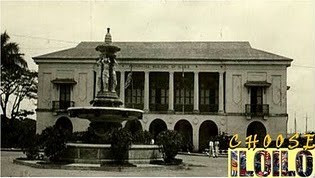
The Capitol Building in Iloilo referred to as the "Casa Real" or Royal House during the Spanish times was built in 1840. The "Casa Real" was the residence of the alcalde-mayor or governor, then the highest Spanish Official in Iloilo. John Foreman, in his book, The Philippine Islands, made mention of this government house. He wrote: (At the extreme end of the Calle Real (now Iznart Street) is a government house, built of wood and stone, and then in a very bad condition but they style is good, has quite the appearance of an official residence. Before it, is a semi-circular garden, and in front of this there is a round fenced-in plot in the middle of which stands a flagpole.

The Flagpole gave way to the Arroyo Fountain in 1927. The "Casa Real" on the other hand was remolded in 1960 after Jose Zulueta became the governor of the province. Though some stone structures might have been preserved, the colonnades at the front of the entire structures were demolished. On November 4, 1998, a fire of unknown source baffled the capitol damaging almost more than the half of the whole building leaving only the main building. This resulted to the construction of a six-storey Provincial Capitol of the future initiated by Gov. Arthur D. Defensor and brought to finish by Gov. Niel D. Tupas, Sr., it now stands behind the original structure.

The Old Iloilo Provincial Capitol was declared by the National Historical Institute as a Philippine Heritage Site and a heritage marker was installed last May 2010. The seat of the Iloilo Provincial Government and the most modern Provincial Capitol in the Philippines


ABS-CBN CORPORATION
THE FIRST TELEVISION STATION IN THE PHILIPPINES

The Philippines' largest network started when Alto Broadcasting System was established by James Lindenberg and Antonio Quirino which was later merged with the Chronicle Broadcasting Network established by the famous Ilonggos Don Eugenio Lopez Sr. & Don Fernando Lopez Sr. and had its first broadcast in 1953.

The nucleus of ABS-CBN began in 1946 with Bolinao Electronics Corporation (BEC). BEC was put up by James Lindenberg, the father of Philippine television an ex-GI and electronics engineer who went into radio equipment assembly and radio broadcasting. At that time, the giant Philippine network was Manila Broadcasting, with DZRH as the top station. In 1949, James Lindenberg shifted Bolinao to radio broadcasting with DZBC and masterminded the introduction of television to the country in 1953.

In 1951, Lindenberg partnered with Antonio Quirino, brother of then President Elpidio Quirino, in order to try their hand at television broadcasting. In 1952, BEC was renamed as Alto Broadcasting System or ABS. "Alto" was a contraction of Quirino’s and his wife’s first names, Tony and Aleli. Though they had little money and resources, ABS was able to put up its TV tower by July 1953 and import 300 television sets. The initial test broadcasts began on September of the same year. The very first full-blown broadcast, however, was on October 23, 1953, of a party in Tony Quirino's home. The broadcasting channel was known as DZAQ-TV Channel 3.

In turn, on September 24, 1956, the Chronicle Broadcasting Network (CBN) was organized. The network was owned by Don Eugenio Lopez Sr. The following year, Don Eugenio acquired ABS from Quirino and Lindenberg. However, it was only on February 1, 1967 that the corporate name was changed to ABS-CBN Broadcasting Corporation (before it was named ABS-CBN Broadcasting Corporation, the name was reverted back to the precursor of the network, Bolinao Electronics Corporation or BEC). In 1958 the network's new headquarters at Roxas Boulevard was inaugurated, and all radio and television operations were consolidated into its two buildings, the radio stations at the Chronicle Building at Aduana Street, Intramuros, Manila, and the TV operations at the brand new Roxas Boulevard building in Pasay City.


ILOILO MISSION HOSPITAL
(Union Mission Hospital)
THE FIRST AND THE OLDEST EXISTING PRIVATE HOSPITAL
IN THE PHILIPPINES

THE FIRST MISSION HOSPITAL IN THE PHILIPPINES

VENUE OF THE FIRST NURSES BOARD EXAMINATION
IN THE PHILIPPINES IN APRIL 1944

IMH is a tertiary training hospital located at Mission Road, Jaro, Iloilo City and was established in 1901 through the efforts of Dr. and Mrs. Andrew J. Hall, missionaries of the Presbyterian Foreign Mission Board, a temporary bamboo clinic was erected at Calle Amparo (now Ledesma Street), Iloilo City, to serve as a venue for the treatment of health care to the very poor. This was made possible because Andrew Hall was a doctor and his wife was a nurse.


CENTRAL PHILIPPINE UNIVERSITY
COLLEGE OF NURSING
(Union Mission Hospital Training School for Nurses)
THE FIRST NURSING SCHOOL IN THE PHILIPPINES

The school was established in 1906 and ran by the Baptist Foreign Mission Society of America. Miss Rose Nicolet, a graduate of New England Hospital for Women and Children in Boston, Massachusetts was the first superintendent for nurses. It moved from its present location to Jaro Road, Iloilo City in 1929. Miss Flora Ernst, an American nurse, took charge of the school in 1942. In April 1944 graduate nurses took the first Nurses Board Examination at the Iloilo Mission Hospital.


ILOTYCIN / ILOSONE (ERYTHROMYCIN)
A DISCOVERY OF DR. ABELARDO AGUILAR
DR. ABELARDO AGUILAR is THE FIRST FILIPINO TO DISCOVER
A MAINSTREAM ANTIBIOTIC

He is a Filipino scientist who sent some soil samples to his employer Eli Lilly in 1949 who managed to isolate Erythromycin from the metabolic products of a strain of Streptomyces erythreus in the soil found in the samples which Dr. Abelardo Aguilar sent. The product was launched commercially in 1952 under the brand name ILOSONE after the Philippine region of Iloilo where it was originally collected from.With the launch of Ilosone, ILOILO became the FIRST AND THE ONLY PROVINCE IN THE PHILIPPINES AND THE WORLD TO HAVE A PIONEERING ANTIBIOTIC BRAND NAMED AFTER IT.


ILOILO - NEGROS AIR EXPRESS COMPANY INC.
FIRST COMMERCIAL AIRLINE OF THE PHILIPPINES AND IN ASIA

FIRST COMMERCIAL ARLINE OF THE PHILIPPINES TO FLY THE INTERNATIONAL SKY VIA THE ILOILO-MANILA-HONG KONG ROUTE.

The airline was founded by the Lopez Brothers on February 3, 1933 but was closed down during the onset of World War II. It was renamed as Far Eastern Air Transport Inc. (FEATI) that became the first commercial airline of the Philippines to fly the international sky via the Iloilo-Manila-Hong Kong route.

FEATI was later acquired by Philippine Airlines that eventually carried the INAEC-FEATI legacy in Philippine and Asian aviation history.


BALUARTE ELEMENTARY SCHOOL
THE FIRST PUBLIC ELEMENTARY SCHOOL IN THE PHILIPPINES


The passage of the Gabaldon Act in 1907 made way for the establishment of the school.

The nipa school started with an enrollment of 65 pupils, including some old folks.
In 1910, Mejica wrote a letter to the Municipal Council of Iloilo to purchase a lot for the school and for this purpose he donated fifty pesos.
The petition was granted and through Municipal Council ordinance No. 241, dated Aug. 15, 1910 , the Council agreed to buy lots to be used as the new and bigger school site.


ILOILO NATIONAL HIGH SCHOOL
THE FIRST PUBLIC & PROVINCIAL HIGH SCHOOL IN THE PHILIPPINES

The history of the Iloilo High School dates back to the later part of 1902 when a school called the Iloilo Normal School was established in a two-storey building in front of and across the street of the present Provincial Building (now Casa Plaza) to meet the future need for Filipino teachers.


FORT SAN PEDRO - ILOILO
THE FIRST SPANISH FORTIFICATION STRUCTURE
IN THE PHILIPPINES

It was constructed to protect Iloilo City Proper from the marauding Dutch and Muslim pirates. The construction began in the early 1600 and was finished in 1616.


HOSKYN & CO.
THE FIRST AND THE OLDEST EXISTING DEPARTMENT STORE AND
SUPERMARKET IN THE PHILIPPINES

In 1877, the Englishman Henry Hoskyn, nephew of Nicholas Loney, the first British vice-consul in Iloilo, paid P17,000 for the house and lot at the midpoint of Calle Real which became the site of the town's renowned luxury Hoskyn Department Store


ILOILO GOLF AND COUNTRY CLUB
THE FIRST AND THE OLDEST EXISTING GOLF AND COUNTRY CLUB
IN THE PHILIPPINES

It has a challenging 18 hole golf course (6,056 yards) carved in the hills of Sta. Barbara, Iloilo was established in 1907.


MUSEO ILOILO
THE FIRST GOVERNMENT-SPONSORED AND CONSTRUCTED MUSEUM IN THE PHILIPPINES

Museo Iloilo features paleontological and archaeological finds in Iloilo and various artifacts relating to Iloilo's history and culture. Notable items are dated fossils, artifacts from sunken vessels, especially, a sunken British vessel, stone age tools, pottery, tradeware from China, Annam and Siam, burial jars and coffins and gold ornaments.


UNIVERSITY OF THE PHILIPPINES-VISAYAS
MIAG-AO CAMPUS
THE BIGGEST UNIVERSITY OF THE PHILIPPINES CAMPUS
THE BIGGEST UNIVERSITY IN THE PHILIPPINES IN TERMS OF LAND AREA

UP in the Visayas in Iloilo was created with the merging of the three UP campuses in the Visayas: UP Cebu, Tacloban and Iloilo. The UPV-Miag-ao campus was later built and majority of the course offerings in the Iloilo Campus was moved there.


JARO EVANGELICAL CHURCH
THE FIRST & THE OLDEST EXISTING CHRISTIAN-BAPTIST CHURCH
IN THE PHILIPPINES

Jaro Evangelical Church was established in 1901 by the Northern Baptists denomination who first came to Iloilo in 1899. The church is now the under the umbrella of the American Baptist Church.


REGENT THEATER (CINE PALACE)
THE OLDEST EXISTING MOVIE THEATER IN THE PHILIPPINES

Regent Theater, formerly known as Cine Palace and Cine Regent was built in 1928. Though its interior was renovated in the early 1980's or late 1970's, it retained its facade in the neo-classical form.


SOUTHEAST ASIAN FISHERIES DEVELOPMENT CENTER
AQUACULTURE DEPARTMENT
THE FIRST INTERNATIONAL RESEARCH CENTER IN THE PHILIPPINES

THE FIRST AQUATIC DEVELOPMENT CENTER IN THE PHILIPPINES
AND IN ASIA

SEAFDEC/AQD was established in 1973 in Tigbauan, Iloilo to conduct research, develop technologies, disseminate information, and train people in the farming of fishes, crustaceans, mollusks, and seaweeds for food, livelihood, equity, and sustainable development.


JOHN B. LACSON FOUNDATION MARITIME UNIVERSITY
THE FIRST MARITIME UNIVERSITY IN THE PHILIPPINES

The John B. Lacson Foundation Maritime University was born from the vision of a young man who pursued his goal with a remarkable passion and zeal that set the tone of leadership in this institution. Master Mariner Juan Bautista Lacson, the founder, first started with a review school for marine officers in May 1931, thus foreshadowing the birth of the Iloilo Maritime Academy in 1948. When it first opened with 60 enrollees, the Academy offered a two-year regular course for cadets in the nautical profession leading to the acquisition of a Third Mate license for merchant marine officers as well as reserved naval officers in the Philippine Navy. By the time it was granted permit to operate in 1949, the school had 150 junior students and 54 seniors.


SM DEPARTMENT STORE - DELGADO, ILOILO
THE FOURTH SM DEPARTMENT STORE IN THE PHILIPPINES
THE FIRST SM DEPARTMENT STORE OUTSIDE MANILA

The store opened in May 1979 and was relaunched in the year 2004. It is the 4th SM Department Store built by Henry Sy Jr. and the first branch opened outside Metro Manila. SM Supermarket was conceptualized and opened its store at SM Delgado in 1985.The mall was relaunched in 2004 and featured anchors like Ace Hardware, Our Home, Surplus Shop and SM Appliance Center.


 MANG INASAL
THE FIRST BARBECUE FASTFOOD CHAIN IN THE PHILIPPINES
The Philippine's fastest growing barbeque fast food chain, serving chicken, pork barbeque and other Filipino favorites, was first established on December 12, 2003 in Iloilo City.

Currently, there are 401 branches nationwide and with over 10,000 employees system wide. MANG INASAL is doing its share in alleviating the unemployment burden of the country. The presence of every MANG INASAL in a certain area provides not only employment but also opportunities to community members including suppliers of kalamansi, charcoal, banana leaves, vegetables, bamboo sticks, and other ingredients.  It also indirectly gives income-generating activities to many.


DISCLAIMER
The pictures are not owned by the blog and its author. They were compiled from different online sources (websites, blogs, etc) and posted by MR. MARK TIMOTHY J. LIBUNAO (blog owner) for information disseminationpurposes only. The CHOOSE ILOILO logo was added for the promotion purposes of Iloilo and anything Ilonggo in nature. No copyright infringement intended.